

Labor Day is supposed to be the day you stop working. I spent mine scrolling for watches, which for me is roughly the same thing as checking work email from a beach chair, except more expensive.
The plan was modest. Find something to daydream about. Something to put at the end of a mental sentence that begins “if 2027 goes well.” Instead of a daydream, I found a storefront selling what it plainly described as a Rolex Daytona (iykyk), for a number that would not cover the sales tax on a real one (literally), inside the Shop app — Shopify’s own consumer shopping platform.
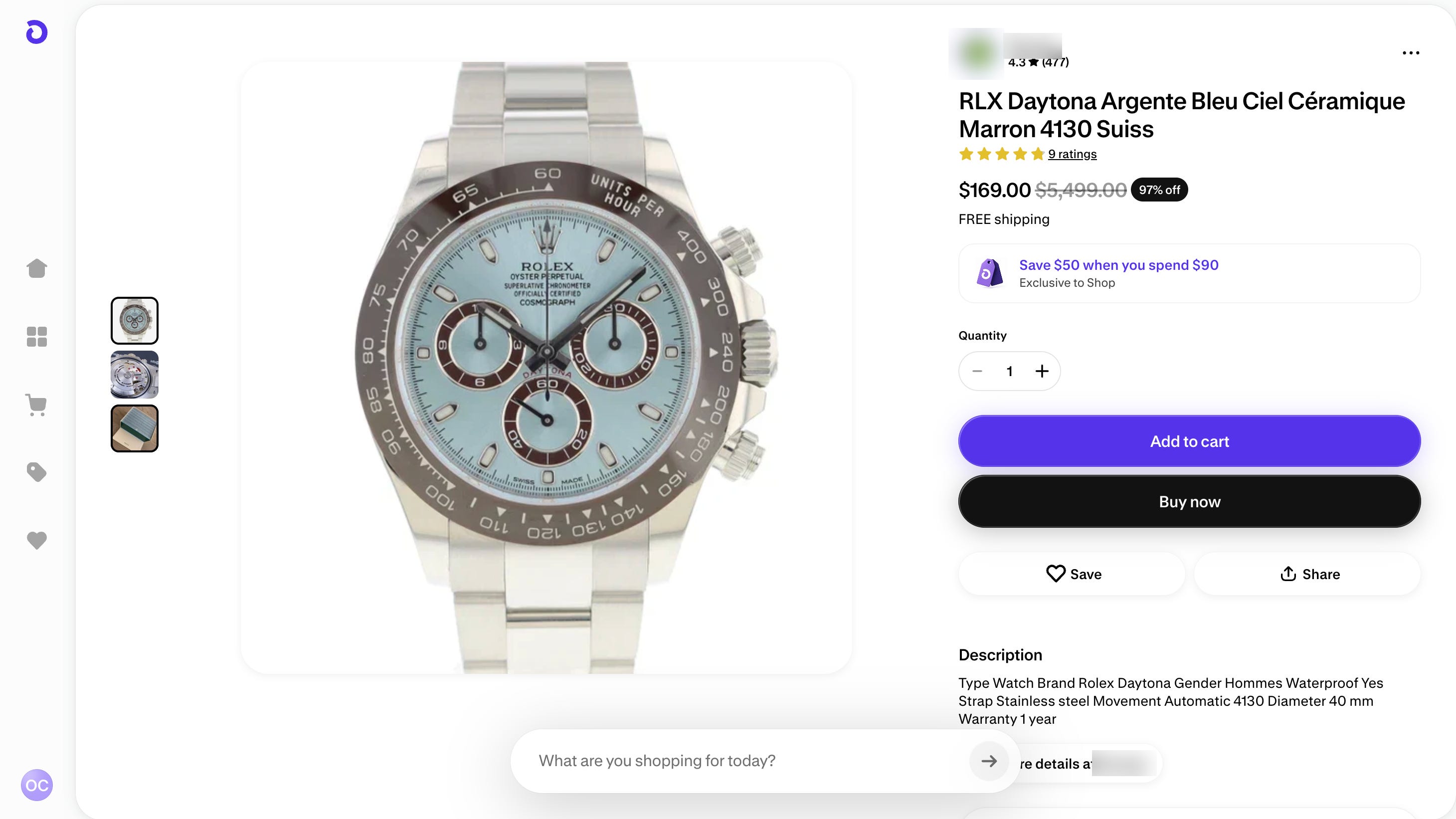
The listing did not hedge. It did not say “homage.” It did not say “inspired by.” It said the name. The crown was on the dial in the photograph. There was even a green box.
I have been writing about this hobby long enough to have made a blind eye to the counterfeit economy. What my blind eye sees now is how relaxed it has gotten.
For your reference, this is the value around which this Daytona would retail for (if genuine, of course):

How it was done before
If you have ever fallen down the AliExpress rabbit hole, you know the choreography. The sellers there are careful in a very specific way: the dial is blank. The crown is gone. The listing calls it “no-logo,” or “inspired,” or gives it an invented brand name assembled from Scrabble tiles. The bezel is right, the case shape is right, the bracelet taper is right, and the one thing missing is the one thing that would make it actionable.
Everybody understands the arrangement. You understand it. The seller understands it. The five hundred reviewers posting wrist shots understand it. The blank dial is not modesty; it is a legal fig leaf the size of a postage stamp, and it works because trademark law cares about the mark.
eBay’s counterfeit policy actually instructs sellers not to hide or blur logos — a rule you only write down when hiding and blurring have become an industry. The dodge is so standard it has generated its own counter-regulation.
On the Shop app, there is no dodge. The mark is right there. Whatever you think about the ethics of the grey market, the plausible-deniability version at least required effort. This required none.
A marketplace (?)
Shopify has spent years insisting it is not a marketplace. It is infrastructure. It is the picks and shovels. It hosts your store; it does not run a mall. In 2021 the company said flatly that it had no plans to be a marketplace, and for a long time the Shop app was defensible as an order-tracking utility that happened to have a search bar.
That is no longer a serious description of the product. In the first quarter of 2026, Shopify told investors the Shop app’s gross merchandise volume was up roughly 70% year over year, monthly active users up more than 40%, and unique buyers purchasing directly in Shop up more than 50%. The company reported $116 billion in total GMV in Q2 2026 and claims north of 14% of U.S. e-commerce. Shop has a discovery feed, personalized recommendations, an AI shopping assistant, a cash-back program, and a MrBeast-sized marketing budget behind it. Merchants do not even have to install the Shop channel to appear in it; eligible stores are added automatically.
What Shop will not sell you
Here is where it gets funny, in the way that things are funny when they are also slightly infuriating.
Shopify publishes a list of product types prohibited on the Shop app specifically. It is not short. You cannot sell alcohol on Shop. You cannot sell many other things, a line of inquiry that raises questions I will not pursue here.
Counterfeits are not on the list. Neither is trademark infringement. Those get handed off to Shopify’s general Acceptable Use Policy.
The current AUP does not contain the word “counterfeit.” It does not contain the word “trademark.” What it contains is this: “The most common product eligibility disputes originate from outside of Shopify… including from regulators and third-party IP rights holders. In these circumstances, we’ll give you notice and tools to self-manage your risks and disputes when appropriate.”
Read that again with a fake Daytona in your hand. Rolex’s trademark attorneys have been recategorized as an external inconvenience, roughly on par with a shipping delay, and the merchant selling clones out of non-Swiss origin is invited to self-manage the dispute. The same policy promises Shopify will “default to enforcement at the product level, and take account-level action as a last resort.”
To summarize the platform’s risk model: a merchant can be trusted to work things out with Rolex.
The scale
U.S. Customs and Border Protection seized nearly 79 million counterfeit items in fiscal 2025, with a combined manufacturer’s suggested retail price above $7.3 billion had they been real. For three consecutive years, the top categories by seized MSRP have been jewelry, watches, and handbags — in that order. Watches are not a footnote in the counterfeit economy. They are the podium.
The Federation of the Swiss Watch Industry estimates more than 40 million fake Swiss watches are produced annually, against roughly 30 million genuine ones. A 2025 OECD study put the value of counterfeits infringing Swiss watch brands at $1.88 billion in 2021 — over 40% of the total value of all goods faking Swiss intellectual property, and equal to 7.7% of legitimate Swiss watch exports. Global trade in fakes across all categories: about $467 billion, or 2.3% of world imports.
DISCLAIMER
Disclaimer: I don’t endorse any of the listings described here, and I make no claim that any seller is a scammer, a fraudster, or selling fakes — only that these listings carry Rolex branding and are priced far below retail, in some cases a few hundred dollars for a watch whose genuine counterpart lists in the tens of thousands. This column is written for entertainment purposes and is not a criminal investigation.